
Did You Know?
In 1919, the Men’s Social Circle decided that they needed a place to meet, so out of their own pockets they paid for the construction of the Men’s Club (located where The Barn is now situated). It contained a comfortable parlor with a fireplace, a small library, a large porch overlooking Flat Creek, and a duck pin bowling alley. The men did not use this space as much as they had thought and the nascent club program was in great need of indoor space. So in 1923 the men turned the building over to the MRA. The bowling alley was especially busy on rainy days! By the 1940s the building was primarily used by the collegiates. However, MRA did not use the facility to sponsor social events, so increasingly the collegiates, whose interests spanned more than hiking and softball, gravitated to “Roy’s,” a roadhouse on Old Highway 70. As one collegian from the time noted, “Obviously, this activity did not meet with great enthusiasm on the part of [the] ‘powers that be.’”
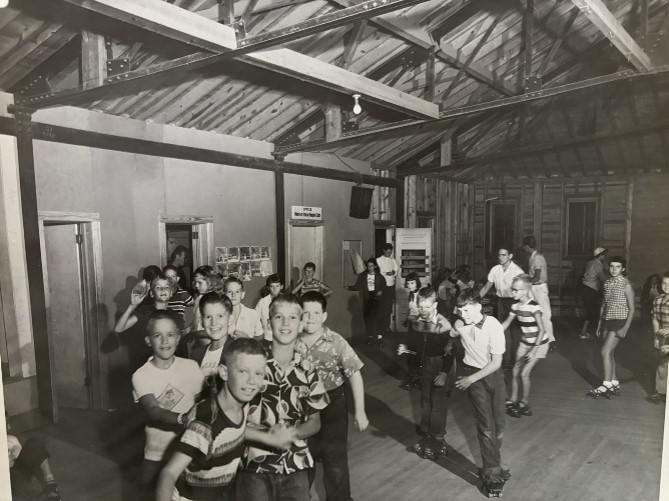
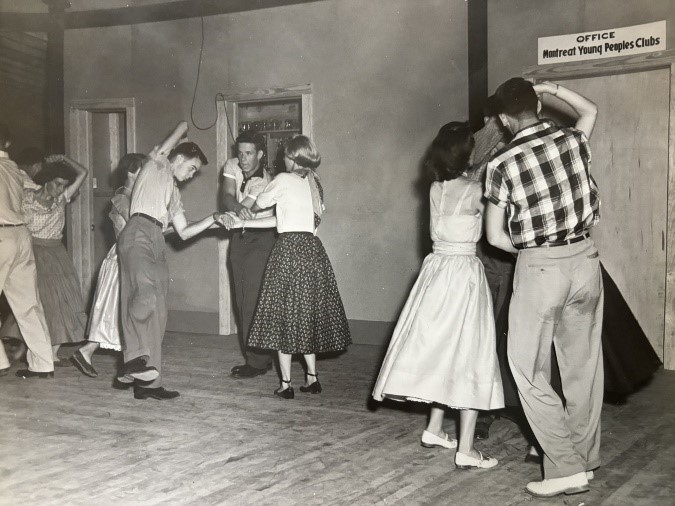
In 1940, the Montreat Women’s Club spearheaded the effort to demolish the building and erect a new one designed specifically for recreational purposes. The cost was $6,000, paid for jointly by Montreat College, the MRA, and the Women’s Club. The building contained a large stone fireplace at one end, a small stage on the side, a room for skate storage, and a small office space. The wooden floor was perfect for skating and dancing (although not to the same music as provided at Roy’s!). The Collegians made good use of the space in the 1940s, practicing plays that they then put on in Anderson Auditorium, dancing to (appropriate) records, and “getting together” when the lean-to attached to the drug store was simply too small. The club programs used it for skating and square dancing for all ages.
But, as happens with most public space over time, it was reconfigured to meet changing needs. The club program also needed a craft shop. In 1956 it was housed in one room in Assembly Inn, clearly not an ideal solution. So, a wall was erected in the building, then known as the skating rink, to create the craft shop, rendering the remaining portion of the building much smaller. As the club programs grew, skating was moved to the basement of McAlister Hall and square dances were often held there as well.
Enter Glenn Bannerman, who became the Program Director for Clubs in 1968. He quickly concluded that the basement of the gym was no place for square dances when right next door sat a building with a wooden floor. That summer several women spruced up the old skating rink with square dance decorations and a regular Friday night dance was opened to all ages. It was packed! The next year, when the old Boys’ Club Building was renovated to become the craft shop, the dividing wall was removed, leaving a much larger floor for dancing. The Stoney Creek Boys, whom Bannerman had hired in 1969 to play for a large square dance on the tennis courts for the World Missions Conference, began providing music for the Friday night dances.
Thus began one of the most beloved traditions of Montreat – the Friday Night Barn Dance. It might be rainy and steamy, it might be chilly, or it might be a lovely mountain evening. No matter. Adults and children alike gather for traditional mountain dancing and, during breaks, novelty dances especially for the young ones. If you live within a half-mile of The Barn you might as well walk to the event because the closest parking is liable to be in the Anderson Auditorium lot. The Stoney Creek Boys still play on many nights, although the membership has changed a bit since 1969. Don’t know anyone? You will by the end of the evening.
There have been modifications to the building since it was first erected in 1940: the wall that created the craft shop, the removal of the same wall, an overhang at the doors, and tiered seating when you just can’t dance another round. Currently The Barn is undergoing a significant renovation to stabilize the building, improve ventilation and restrooms, and ensure that it remains a safe and friendly environment for future generations of Montreaters.