
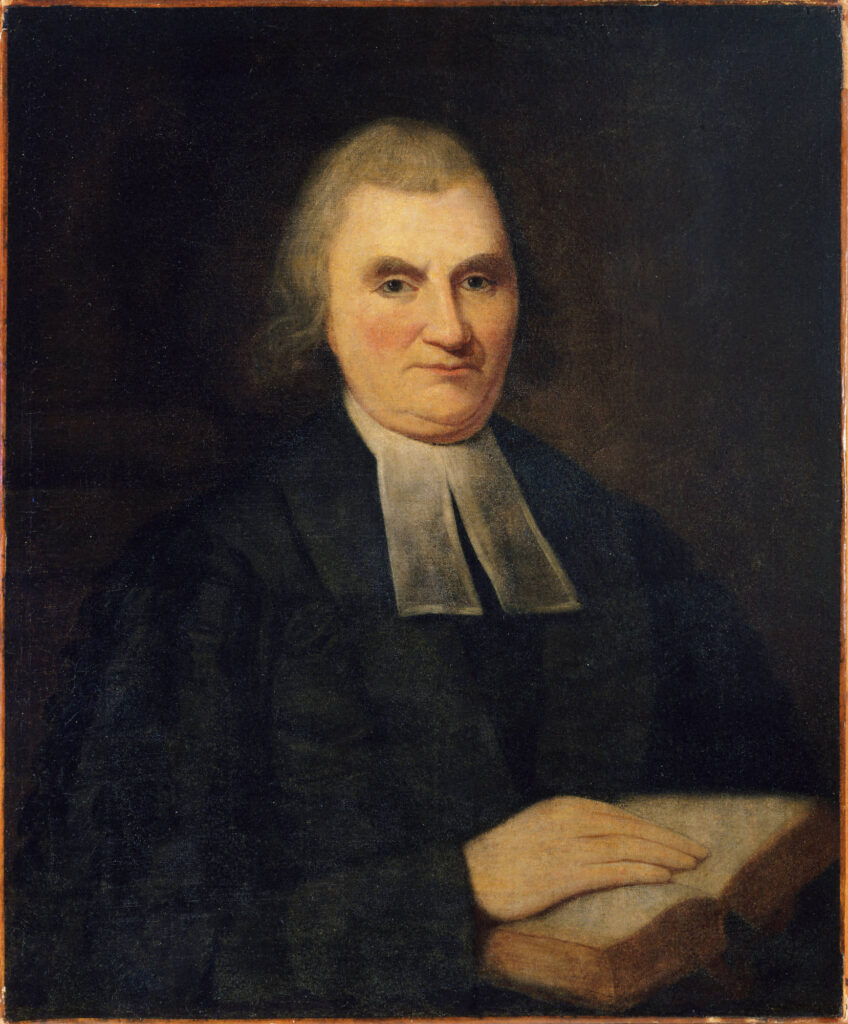
During this 250th anniversary of the Declaration of Independence, Presbyterians remember Scottish-American Presbyterian minister, educator and statesman John Witherspoon (1723–1794). We focus on the “American” chapters of his life, during which he served as president of the College of New Jersey—now Princeton University—and was the only clergyman to sign the United States Declaration of Independence. His leadership helped shape both American higher education and the moral philosophy of the emerging United States. He also played a central role in the formation of the Presbyterian Church in the United States of America (PCUSA). He was the convening moderator of the First General Assembly of the PCUSA, which convened in 1789 in Philadelphia.
Dr. Mark Valeri, this year’s lecturer at the PHC’s Distinguished Lecture on the Reformation, will speak on John Witherspoon and undoubtedly cover all these contributions of Witherspoon to the United States and to both education and Presbyterianism in our country. But what we often overlook is the role Witherspoon played in the development of the Presbyterian Church in Scotland during the 18th century, before he was persuaded by Benjamin Rush and Richard Stockton, on their second attempt, to come to America and serve as president of what is now Princeton University.
The 18th century was a defining period for the Church of Scotland. It moved from post-Revolution settlement and Presbyterian consolidation into an era marked by patronage disputes, theological moderation, evangelical revival and ultimately schism. Major development during this period included the following:
- Post-Revolution Settlement and Stability
After the 1688–89 “Glorious Revolution,” Presbyterianism was firmly established in Scotland. In 1690, the Scottish Parliament abolished episcopacy and confirmed Presbyterian church government as the national system. By the early 18th century, the Church of Scotland was governed by presbyteries, synods and the General Assembly, without bishops. It was closely tied to the Scottish state, especially after the 1707 Acts of Union with England. The Church saw itself as guardian of Scotland’s Reformed identity and moral life.
However, tensions were already forming beneath the surface. The first major point of tension resulted from the 1707 Acts of Union, which subjected Scotland to the decisions of the British Parliament. It should be noted that the 1707 Acts of Union continue to cause tension in Scotland in modern times.
- The Patronage Controversy
The major event precipitating this controversy was the Patronage Act of 1712 passed by Parliament. This legislation restored the right of the aristocracy/landowners to present ministers to vacant parishes. Opposition in Scotland erupted immediately. Among other things, many Presbyterians believed congregations should effectively choose their own ministers. Patronage was viewed by critics as state-over-church intrusion. Congregations sometimes resisted imposed ministers, leading to disputes and even physical confrontations. The patronage issue would dominate Scottish ecclesiastical politics for over a century.
- The Rise of Parties: Moderates vs. Evangelicals
During the first half of the century, two informal parties emerged within the Church of Scotland, moderates and evangelicals. The moderates were strongly influenced by Enlightenment thought. They emphasized reason, compassion, moral preaching and social refinement. They were also often supportive of patronage and aligned with the landed gentry and other cultural elites.
The evangelicals emphasized genuine piety, Calvinist orthodoxy and experiential religion, were more sympathetic to congregational participation in ministerial calls and were concerned about spiritual decline and doctrinal laxity. They believed in covenant theology, which placed great emphasis on the Westminster Confession of Faith.
This division reflected broader and to some extent conflicting societal currents in Scotland. The influence of the Scottish Enlightenment had a major influence on much of Scottish society and culture. At the same time, movements of evangelical fervor, influenced by the Great Awakening in colonial America, were popular in many parts of Scotland.
- Secessions from the Church of Scotland
The first major rupture came in 1733. Ebenezer Erskine and others protested patronage and what they saw as doctrinal decline. After being rebuked by the General Assembly, they formed the “Associate Presbytery.” This led to the “First Secession,” eventually creating the Secession Church, separate from the established Church of Scotland.
There was also a network of “societies” known as the “Covenantors” who had refused to join the Church of Scotland. They believed the national Church was built on an unholy compromise which allowed state control over church. They also emphasized the importance of covenant theology. These Covenantor societies came together as a new Presbyterian denomination in 1943, when the “Reformed Presbytery” was established.*
The “Relief Presbytery” was formed in 1761, also arising out of dissatisfaction over patronage and church discipline. Fife’s Thomas Gillespie led the formation of this denomination. The group was more liberal than the Seceders and Covenantors but fiercely objected to patronage. The name was chosen because the new denomination offered “relief” from patronage.
So by the 1760s, Presbyterianism was no longer institutionally unified in the Church of Scotland. Although the different denominations that arose were theologically similar in many respects, differences separated them.
The Work and Role of Witherspoon in the Church of Scotland
In the midst of these developments within the Church of Scotland, as well as other transformative historical events during this period, such as the Scottish Enlightenment and the Jacobite Uprising in 1745, a young minister from East Lothian named John Witherspoon emerged as the champion and most articulate leader of the evangelical party. He grasped the strengths and weaknesses of the moderates more than most. He defended confessional Calvinism, opposed what he saw as theological dilution among moderates and harshly critiqued sermons that he believed reduced Christianity to mere moral philosophy. He wrote several theological works, the most well known of which was a devastating anti-moderate satire entitled Ecclesiastical Characteristics, published in 1753. It was an influential satirical attack on the moderate clergy. It was so well written and humorous that even the moderates admired it and bought copies.
The evangelicals were given the name “Popular Party,” which Witherspoon adopted with pride. He and his fellow evangelicals considered themselves preachers to the average rural and urban folk that were the bedrock of the Church. Witherspoon believed these people deserved a say in who would be their minister and in how the Gospel would be preached in their Parish Kirk.
But unlike the Seceders, the Covenanters and the Relief Church, Witherspoon did not spurn the Church of Scotland. He chose to stay within the established Church and fight the theological battles he felt were important from within the institution. While he sympathized with concerns about spiritual decline and doctrinal laxity, he believed reform should occur within the national Church rather than through separation. As a result, he strengthened the evangelical party inside the establishment. He also helped prevent evangelicalism from being identified exclusively with secession movements.
Witherspoon’s role is especially important because he did not simply reject Enlightenment thought. He criticized its excesses and religious skepticism. He was also a strong proponent of Scottish common-sense realism (which also greatly influenced Thomas Jefferson and his drafting of the Declaration of Independence), a realist school of philosophy that arose in the Enlightenment out of the thoughts of Aberdeen’s Thomas Reid. Witherspoon engaged intellectually with figures such as David Hume and Francis Hutcheson, opposing theological aspects of their views but at the same time adopting components of their moral philosophy. He helped shape an enlightened evangelicalism—defending orthodoxy while employing and not shunning modern intellectual thought.
Witherspoon was also a Scottish nationalist and supporter of republicanism. He was opposed to the Jacobite Uprising in 1745. Following the Jacobite victory at the Battle of Falkirk, he was briefly imprisoned at Doune Castle, which had a long-term effect on his health.
In summary, Witherspoon’s role in the Church of Scotland’s 18th-century development can be described as:
- A consolidator of evangelical resistance within the establishment.
- A defender of confessional Calvinism against the more liberal reform sought by the moderate party.
- An intellectual bridge between Reformed theology and Enlightenment philosophy.
Witherspoon refused to cause a schism, but he was not afraid to be a harsh critic. He insisted on the importance of theology and doctrine, and not allowing them to become reduced to unimportance by modern thought and conventions. The combination of Witherspoon’s straightforward conviction supporting orthodox Reformed theology, his democratically oriented political thought and his ability to bridge the fissure (at least to some degree) within the Church of Scotland, as well as an intellect that ranked among the many outstanding minds of the Scottish Enlightenment, particularly attracted Benjamin Rush and Richard Stockton when they went about choosing a new president for the College of New Jersey in America.
*Seceders and Covenantors who came to America were the principal founders of the Associate Reformed Presbyterian denomination in the United States, which was formed in 1782 in Philadelphia.