Did You Know?
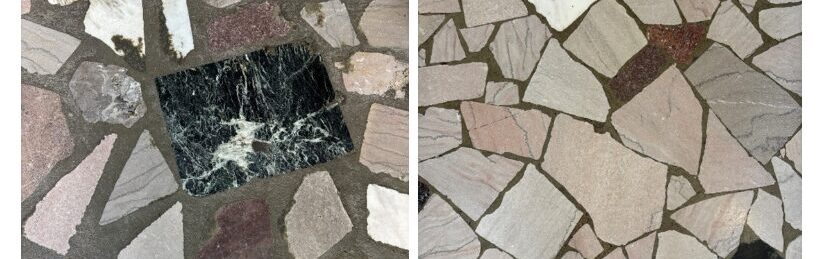
Can you identify which floor above is Anderson Auditorium and which is Assembly Inn?
This month’s Did You Know is thanks to an inquiry from Kat Achtemeier, who asked about the beautiful stone floors in many of the buildings from the 1920’s and 1930’s.
These buildings, including Anderson Auditorium, Assembly Inn, Gaither Hall, and the Way Out, share many common features and often were the result of President R. C. Anderson’s careful financial planning. For instance, when asked why the Assembly Inn was not built of brick, Dr. Anderson replied that “we could get better results for less cost.” He then proceeded to explain all the costs involved with using brick, as opposed to the cobblestones (river rock) which workers could simply harvest from Flat Creek. When they needed more, they opened the valves on the dam and the rushing water brought a fresh supply.
While the marble used in the floors did not come from Flat Creek, it was none the less “scrap” material. The Gray-Knox Marble Yards of Knoxville, Tennessee, donated the “scrap” for Assembly Inn. Workers there loaded it into rail cars free of charge. Montreat had to pay the freight to Black Mountain and then drayage to Montreat.
The labor on these buildings was completely local. Dr. Anderson hired Asheville architects to provide structural design but did the general contracting himself. He hired local foremen and some skilled craftsmen who trained workers to build with the cobblestones and lay out the marble floors. The mosaic design on the floors, while the result of using “scraps,” created an intriguing and beautiful effect. In many cases the individual pieces have their own unique pattern of veins and color shading.
The next time you are in one of the buildings, look closely at the floors. You will see large pieces and small, fit together to best utilize their irregular shapes. Marvel at the intricate patterns and subtle hues of pink that enhance the lighter pieces, and purple that enhance the darker pieces. Legend has it that some of the workers etched small faces onto some of the pieces, but this author has never seen one.
Ed. Note: During the construction of the Montreat Town Hall in 2020, we adopted Dr. Anderson’s approach of “scrap” marble pieces on the lobby floors. The tradition continued.
Thanks to the Presbyterian Heritage Center, especially Nancy Midgette, for this glimpse from the past. Stop by the PHC for additional Montreat history and so much more. Have an idea for a future “Did You Know?”? Let Nancy know at midgette@elon.edu.
Answer to above photo quiz: the left photo is Anderson Auditorium, the right is Assembly Inn